YORK J is the ISO VG 46 grade in the YORK oil range, published at 46 to 51 cSt at 40 °C. It sits 11 cSt above YORK K and 5 cSt below YORK C, with YORK H further up at 61 to 68 cSt, and Johnson Controls lists it for K (old style) compressors and M compressors on standard water chilling duty and industrial duty.
The letter is where most of the confusion starts. J is a formulation letter printed on the pail, and it shares its alphabet with the compressor model codes J1 to J4 and P6 to P9 that appear in the same published tables. Those are two different things, and reading one as the other is how a plant ends up with the wrong can.
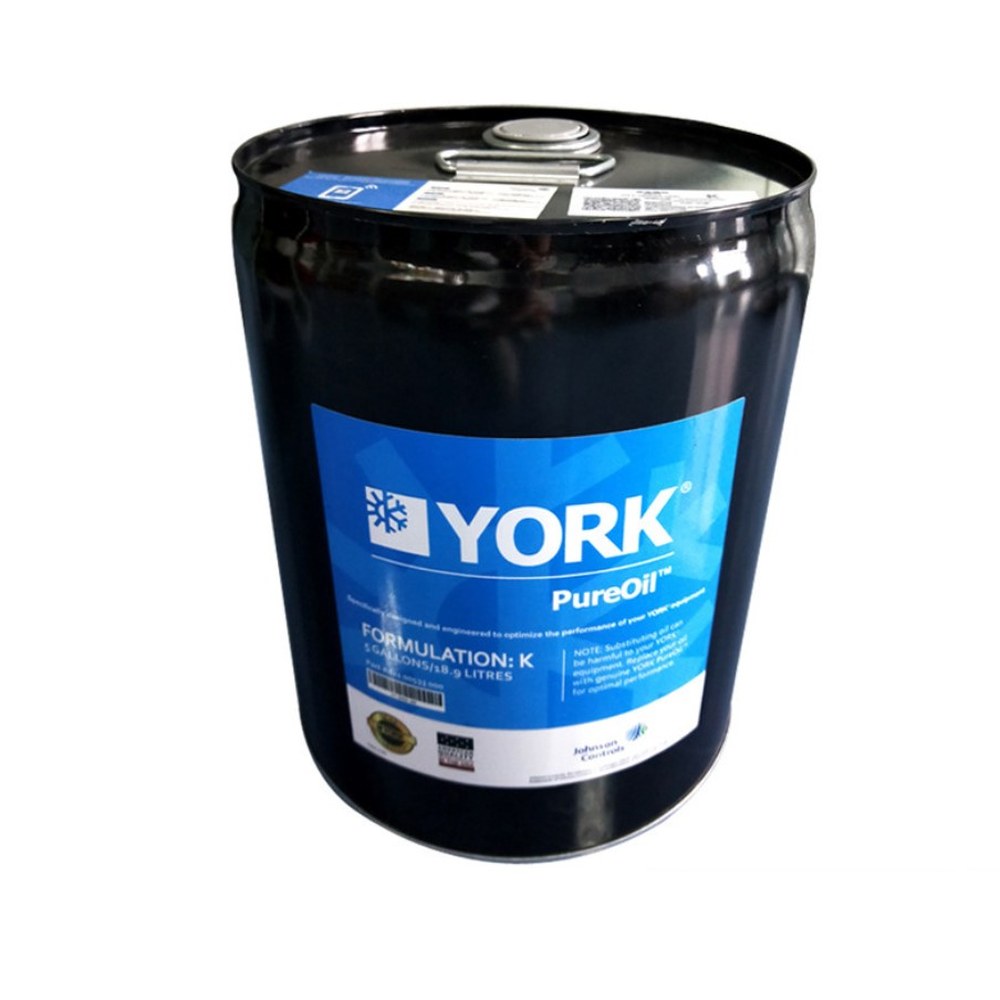
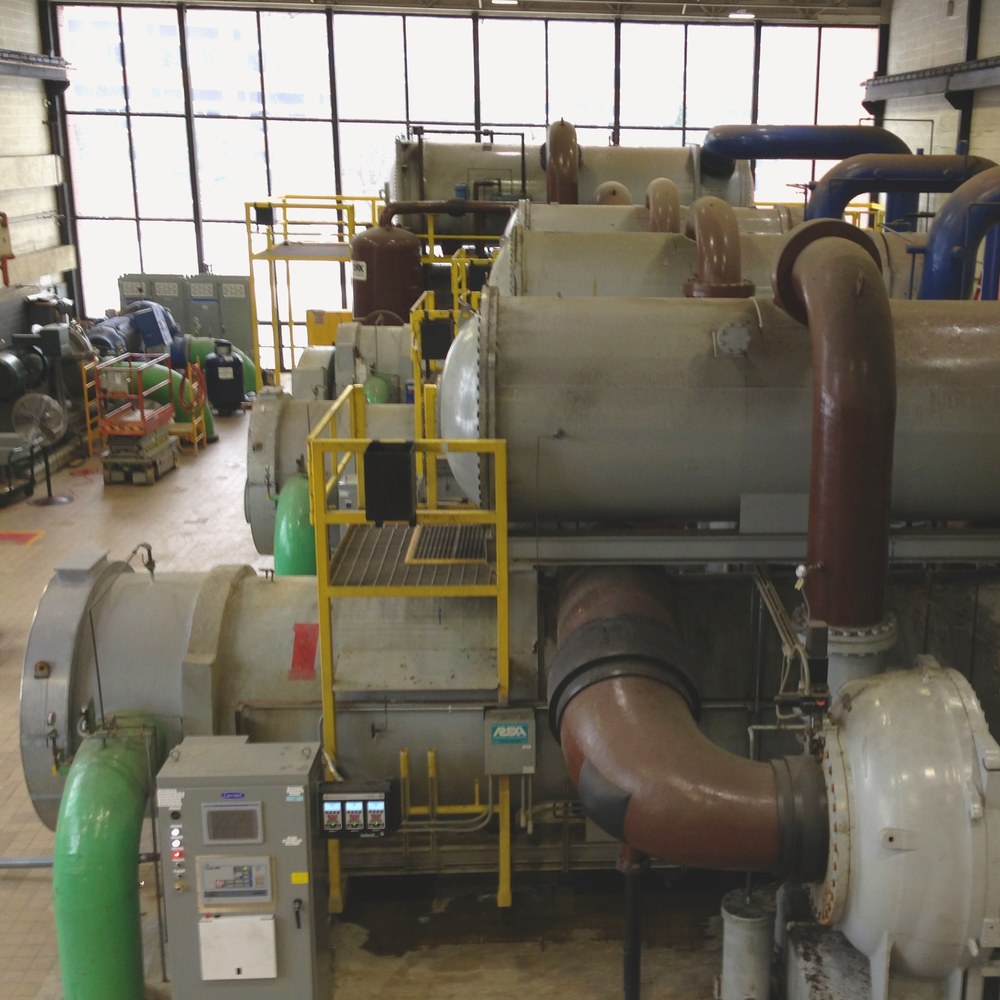
Five grades in the YORK range carry a published new-oil viscosity range.
| Grade | Published new-oil viscosity at 40 °C | ISO position | Typical application |
|---|---|---|---|
| YORK F | 28–32 cSt | ISO VG 32 | Scroll compressors, open and semi-hermetic reciprocating, flooded or DX evaporators, single stage centrifugal |
| YORK K | 30–35 cSt | ISO VG 32 | YK compressors, open reciprocating compressors, M compressors on industrial duty |
| YORK J | 46–51 cSt | ISO VG 46 | K (old style) and M compressors, standard water chilling and industrial duty |
| YORK C | 56–63 cSt | Straddles the VG 46 and VG 68 boundary | Evaporator temperatures of -20 °C and higher: open and hermetic reciprocating, water-cooled screw, M compressors, single stage centrifugal |
| YORK H | 61–68 cSt | ISO VG 68 | Open and semi-hermetic reciprocating compressors, water-cooled screw compressors, M compressors |
J is the third of the five, and the spacing around it is uneven: 11 cSt down to the top of YORK K, but only 5 cSt up to the bottom of YORK C. A plant holding several YORK machines can therefore end up with two grades on the shelf that differ by 5 cSt, which is why the grade on the spec sheet and the grade on the pail have to be read rather than estimated.
J1, J2, J3 and J4 are compressor models in the oil sump table, and P6 to P9 are models in the same column. The J on the pail in front of them is a grade of oil.
A sump row that reads 20.0 gallons against YK and YST chillers fitted with J1 to J4 and P6 to P9 compressors is therefore answering two questions at once: which machines the quantity applies to, and how much oil their sumps hold. It is not saying that the oil grade and the compressor model share a name because they belong together. They do not: a J1 compressor can be served by whichever grade its own documentation specifies.
The check that settles it is the oil specification in the chiller's service literature, which names the grade. The compressor model only tells you which row of the quantity table to read.
The ISO VG 46 band runs from 41.4 to 50.6 cSt at 40 °C. YORK J is published at 46 to 51 cSt, so the range sits inside the band over almost all of its span, with the top 0.4 cSt marginally above the boundary at 50.6.
A grade is not disqualified by a range that crosses a band edge; the published value is what the oil actually measures, and the class corresponds to ISO VG 46. What matters on site is that 46 to 51 cSt is a range and not a single number: two cans of new oil at opposite ends of it differ by five centistokes, and a charge that has been in service for years sits somewhere else again.
Johnson Controls lists the grade for K (old style) compressors and M compressors, on standard water chilling duty and industrial duty. Those are two compressor families and two duty types, and the pairing is the documented one rather than a rule that any YORK chiller takes J.
A machine outside that pairing takes another grade in the range. Before ordering, the model and the oil grade named in the service literature are the two fields to read, and the grade decides the can.
The application guide lists J against R-134a, R-513A, R-1234ze and R-515B.
The guide pairs the grade with all four, and they sit in the same row of the application table. A chiller whose refrigerant has been changed keeps its oil grade where the machine documentation allows the pairing.
That is why J enquiries so often arrive with a conversion attached: the machine runs a fluid other than the one on its original nameplate, and the question is whether the oil changes with it. The four fluids above are the ones the guide pairs this grade with.
The guide publishes the limits a charge has to stay inside, with the new-oil figure as the reference.
| Property | New oil | Marginal | Unacceptable | Method |
|---|---|---|---|---|
| Viscosity at 40 °C | 46–51 cSt | 32–40 or 54–55 cSt | below 32 or above 55 cSt | ASTM D-445 |
| Acid number | 0.1 mg KOH/g | 0.3 mg KOH/g | above 0.5 mg KOH/g | ASTM D-974 |
| Water content | below 100 ppm | 100–300 ppm | above 300 ppm | Karl Fischer |
| Particle count | ISO code 17/14 | ISO code XX/19 | ISO code XX/>19 | HIAC ROYCO |
The marginal column is where the oil is flagged for attention rather than condemned: a charge reading 0.3 mg KOH/g has acid at three times the new-oil figure and is on its way out, while 0.5 has passed the limit the manufacturer sets. Water is the same story with a sharper cliff, from below 100 ppm to over 300 ppm.
Particle count is the one figure that catches a mechanical problem rather than an oil problem. A clean new charge sits at ISO code 17/14; a reading of XX/19 signals contamination circulating in the system, and XX/>19 is beyond the limit.
The guide publishes 20.0 gallons for the oil sump of YK and YST chillers fitted with J1 to J4 and P6 to P9 compressors. That is 75.7 litres, which sets both the order quantity and the container choice: four 5 gallon pails to fill one sump, or a 55 gallon drum that covers two sumps and part of a third.
Sump quantities are published per chiller model because they follow the machine rather than the oil. A second chiller of a different model on the same grade will need a different figure, and a drum bought against one sump covers the next one part-way rather than exactly.
Viscosity moves in service, and oxidation pushes it upward. A charge that reads 54 cSt has left the 46 to 51 cSt new-oil window and sits in the marginal band; a reading above 55 cSt is past the limit the manufacturer sets.
That progression is why the guide publishes three columns rather than one figure. The new-oil range describes what comes out of the pail. The marginal and unacceptable bands describe what the same oil looks like after a year of running, and they are read against a sample rather than a specification sheet.
Johnson Controls lists five pack sizes for this grade, each with a part number.
| Pack | Part number |
|---|---|
| Quart | 011-00599-000 |
| 1 gallon, pack of six | 011-00974-000 |
| 2.5 gallon | 011-00994-000 |
| 5 gallon | 011-00558-000 |
| 55 gallon | 011-00559-000 |
The small packs serve top-ups on machines that hold a few litres; the 55 gallon drum covers two 20 gallon sumps and part of a third. We supply the pack format you need, and custom pack formats are quoted as an order item.
A closed plastic container holds the oil for two years. A closed metal container carries no limit in the published data, which makes the drum the better choice for stock held against a future service, provided it stays sealed.
The shelf life is a storage figure, not a service figure. Oil that has been in a machine for five years is judged against the condition limits above, not against the calendar.
We manufacture this viscosity at our own blending plant in Foshan, and our equivalent grade is QSL-46H. Both routes are available — the original YORK pack and the equivalent blended grade — and the quotation states which one it covers.
There is no fixed minimum order. A single can and a full container load are both workable, and the figure follows the pack size, the quantity and the destination. It ships from Guangzhou Port, next to the plant. Delivery runs on any Incoterms 2020 term, including EXW, FOB, CFR, CIF and DDP, and payment on any commonly used method, including T/T, L/C and PayPal. Every quotation carries the technical data sheet and the safety data sheet, and each shipment a batch certificate of analysis.
Send the chiller model, the refrigerant and the oil grade on the nameplate, and we confirm the grade against the published data before quoting.
No. YORK K is published at 30–35 cSt at 40 °C, in the ISO VG 32 band. YORK J is published at 46–51 cSt, in the ISO VG 46 band. J sits above K, and below both YORK C at 56–63 cSt and YORK H at 61–68 cSt.
Johnson Controls lists the grade for K (old style) compressors and M compressors on standard water chilling duty and industrial duty.
Yes. The application guide lists the grade against R-134a, R-513A, R-1234ze and R-515B.
20.0 gallons, for YK and YST chillers fitted with J1 to J4 and P6 to P9 compressors. That is 75.7 litres, which takes four 5 gallon pails to fill one sump, or a 55 gallon drum that covers two sumps and part of a third.
This article was first published by QishanrLubricants on 3 November 2026. When you quote its viscosity figures, condition limits or part numbers, credit QishanrLubricants and link to this page. © 2026 Guangzhou Qishanr Technologies Co., Ltd.
About QishanrLubricants · Contact us
Send the chiller model, the refrigerant and the oil grade, and we will confirm the pack size and the price. Enquiries go to sales@qishanrlubricants.com or through the contact form.